HushAsk Blog
Practical writing on anonymous Slack feedback, the difference between cryptographic and policy anonymity, and how teams actually get honest feedback when nobody knows who's asking.
We cover the technical side (SHA-256 hashing, Slack platform constraints, the Enterprise Grid caveat), the human side (why employees don't trust anonymous tools, what changes when they do), and the practical side (how to roll feedback out, what to do when the answer is hard). New posts twice a week.
Anonymous Onboarding Feedback: What New Hires Won't Tell You in Week One
New hires see every broken thing in your onboarding and are the least likely to say so with a name attached. What to ask at 30, 60, and 90 days, why anonymity matters most for the newest people, and how to run a recurring check-in in Slack.
Read article →
Mid-Year Review Season: Anonymous Questions That Surface Real Signal
Mid-year reviews collect less than annual ones, and the reason is structural. Four question shapes that surface signal at the half-year mark, a 10-question library you can use verbatim, and how to pre-commit to acting on what you hear.
Read article →
Running an Anonymous All-Hands AMA in Slack
The interesting all-hands questions never get asked out loud. A practical guide to running an anonymous AMA in Slack — collecting questions ahead or live, moderating without de-anonymizing, and a 5-minute setup.
Read article →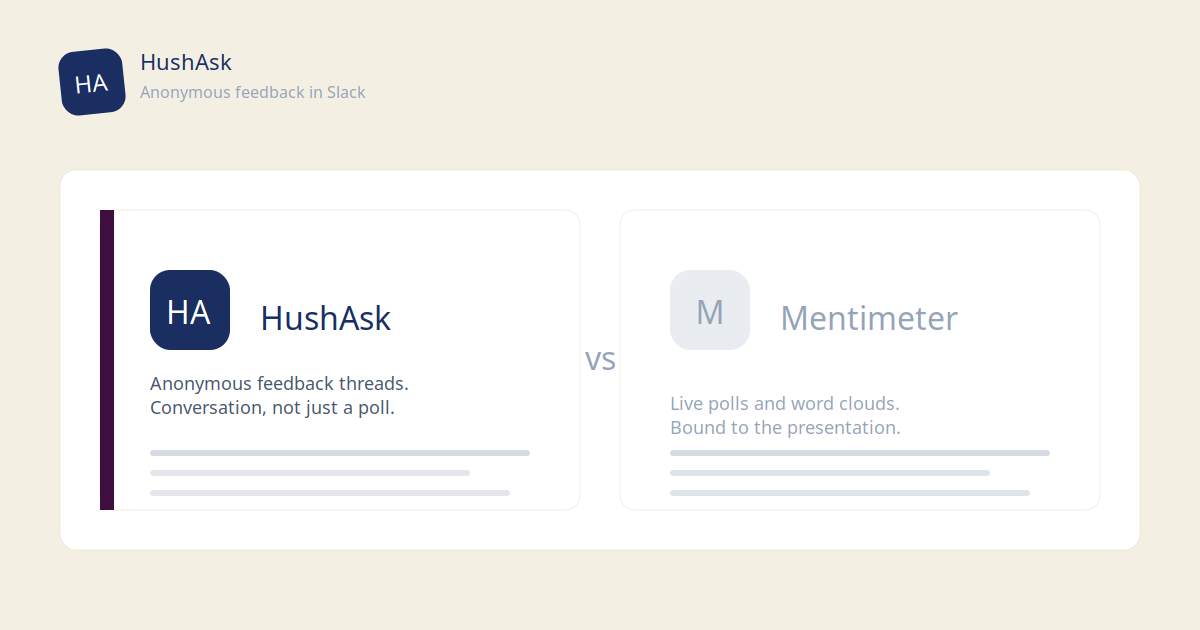
HushAsk vs Mentimeter: Live Polls vs Anonymous Feedback Threads
An honest comparison of HushAsk and Mentimeter. Mentimeter runs live polls and word clouds for the room; HushAsk runs two-way anonymous feedback threads in Slack. What each does well, and when to pick which.
Read article →
HushAsk vs Slido: Anonymous Q&A for All-Hands vs Everyday Slack
An honest comparison of HushAsk and Slido. Slido runs live Q&A for the all-hands; HushAsk runs always-on anonymous Q&A in Slack. Different jobs, often confused — when to pick each, and why teams run both.
Read article →
Where Anonymity Quietly Fails in Slack Connect and External Channels
Three concrete places anonymous bot interactions get more complicated inside a Slack Connect channel, why most anonymous-feedback tools do not talk about it, and practical guidance for when to use Connect for anonymous flows.
Read article →
HushAsk vs Lattice: Performance Reviews vs Anonymous Feedback
An honest comparison of HushAsk and Lattice. Different categories, different timescales — performance reviews vs always-on anonymous conversation. When to pick each, and why teams often run both.
Read article →
Running Anonymous Exit Interviews in Slack
Why traditional exit interviews produce sanitized data, and how to fix it with an asynchronous anonymous Slack flow. A 10-question template plus a quarterly pattern-spotting discipline.
Read article →
HushAsk vs Culture Amp: Where Each One Wins
A category-honest comparison of HushAsk and Culture Amp. Different problems, different shapes, different buyers — and the pattern that works for teams that need both.
Read article →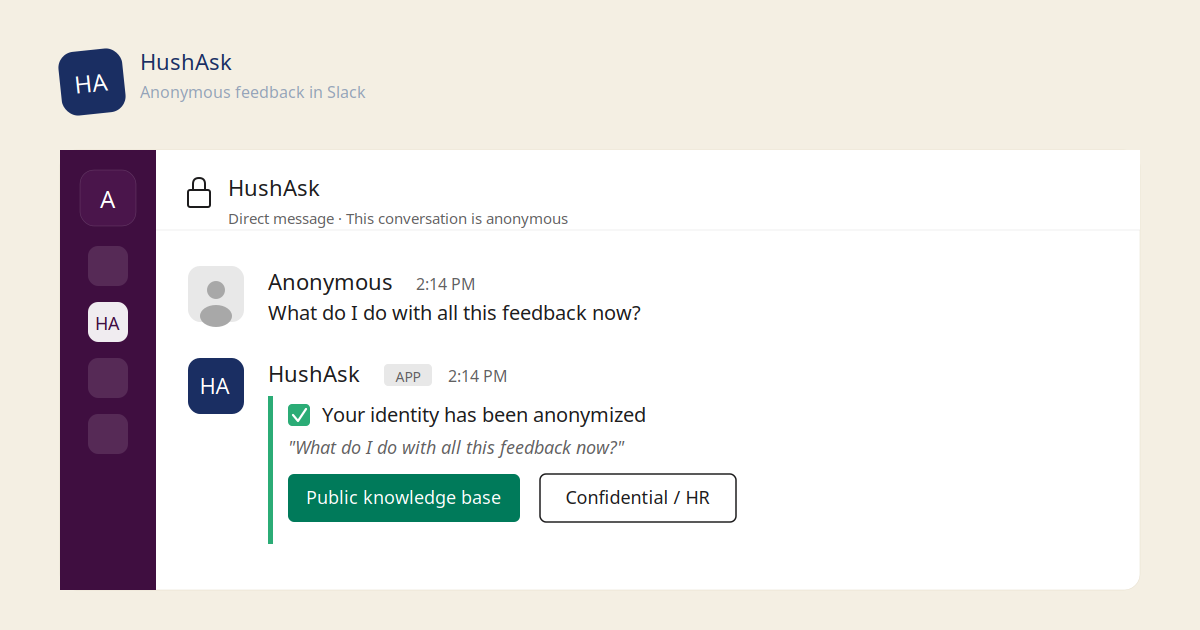
Three Questions to Ask After Every Anonymous Feedback Round
The 48 hours after an anonymous feedback round closes determine whether the channel survives. A three-question discipline that protects against the two most common failure modes.
Read article →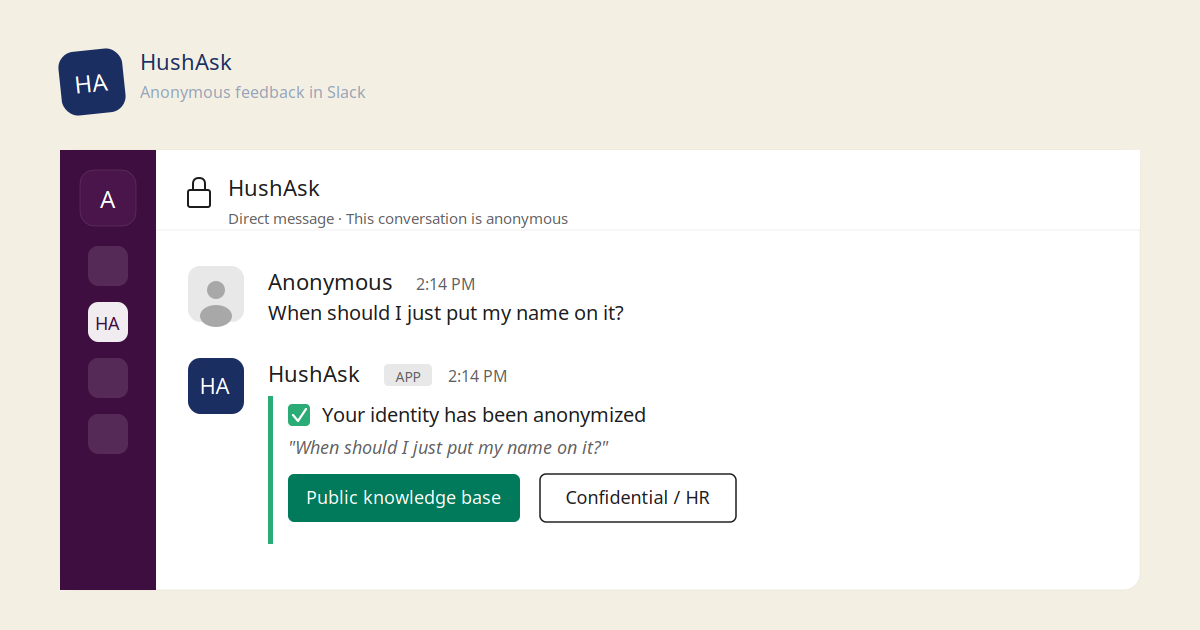
When to Use Anonymous Feedback vs Named Feedback (and How to Tell)
A practical decision framework for choosing between anonymous and named feedback channels. Four cases where each one wins, and a hybrid pattern that beats both.
Read article →
HushAsk vs 15Five: Continuous Feedback vs Anonymous Q&A
An honest comparison of HushAsk and 15Five — where 15Five's named continuous-feedback model wins, where it leaves gaps, and when running both is the right call.
Read article →
Anonymous Skip-Level Feedback in Slack
A practical guide to running skip-level feedback through an anonymous Slack channel: three patterns that surface real signal, and what to do with what you hear.
Read article →
HushAsk vs Officevibe: Where Each One Wins
Officevibe is built for pulse engagement surveys at the org level. HushAsk is built for ad-hoc anonymous Q&A in Slack. A practical comparison of when each one fits.
Read article →
Why Anonymous Feedback Fails in Remote Teams (and What Fixes It)
Remote teams don't have a feedback problem. They have a hallway-conversation problem. Three patterns that actually work — and where the tool stops mattering.
Read article →
HushAsk vs Geekbot: Anonymous Standups vs Anonymous Q&A
Geekbot is built for scheduled async standups and recurring polls. HushAsk is built for on-demand anonymous Q&A. A comparison on what each tool does well and which one fits which job.
Read article →
Anonymous Performance Review Feedback: Asking the Right Questions
A library of 12 anonymous review questions, organized by what you want to learn. Plus a framework for the four question shapes that actually surface signal.
Read article →
What to Do With Anonymous Feedback You Didn't Want to Hear
A practical playbook for the first 24 hours after receiving anonymous feedback that lands hard. Three questions for separating signal from noise, and what employees notice when you respond well.
Read article →
Setting Up an Anonymous Suggestion Box in Slack (Without Google Forms)
Suggestion boxes don't fail because nobody has ideas. They fail because nobody trusts where the ideas go. Three patterns that work in Slack, and how to set one up in five minutes.
Read article →
HushAsk vs Polly: Anonymous Feedback in Slack
Polly is the most-installed Slack feedback tool. HushAsk is built differently. A practical comparison on anonymity model, conversation shape, and which one fits which team.
Read article →
Are Google Forms Actually Anonymous for Workplace Feedback?
Google Forms can be set to anonymous, but Workspace audit logs and narrow demographic questions often leak identity anyway. Here's what Google records.
Read article →
HushAsk vs. Abot: Which Anonymous Slack Tool Actually Protects Identity?
Both tools promise anonymity. One backs it with cryptography. A straight comparison on what actually happens to your Slack user ID.
Read article →
Building a Team Knowledge Base from Anonymous Q&A
Most knowledge bases fail because nobody writes things down proactively. Anonymous Q&A flips the model — questions get asked, answered, and saved to Notion automatically.
Read article →
Why Your Employees Won't Use an Anonymous Feedback Tool (and How to Fix It)
Low participation isn't apathy — it's a rational response to broken promises. Here's what actually changes it.
Read article →
Is Anonymous Feedback in Slack Actually Anonymous?
"Anonymous" usually means someone promised not to look. Cryptographic anonymity means the information doesn't exist. Here's the difference — and how to check which one you have.
Read article →
How to Collect Anonymous Employee Feedback in Slack
Most anonymous feedback tools make a promise. HushAsk makes it technically impossible to identify you. Here's what that difference means in practice.
Read article →